Battle of Britain and the Blitz
Pamela's WarThe Battle of Britain and the Blitz enter Pamela Wheeler Fellows’s memoir not as a military chronicle but as an escalating pressure on homes, work, family life, and the places people thought safe. The attacks are meant to break the population’s spirit, yet the narrative sets that purpose against a different outcome: fear and loss persist, but shared hardship draws people closer and ordinary acts of protection become part of the war effort.
The air war reaches beyond London
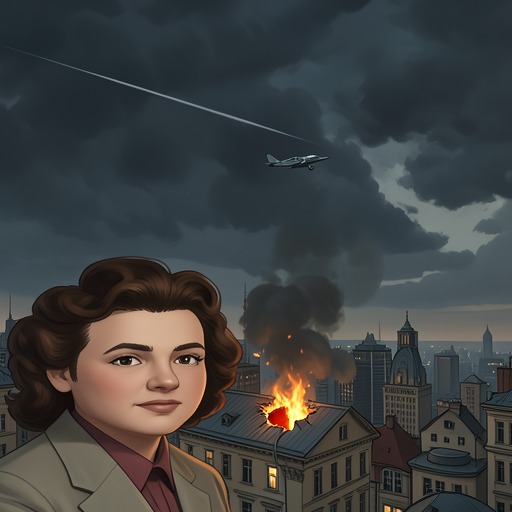
The account first presents the bombing as sustained and national in its reach. London endures months of nightly attacks, and the threat then extends to provincial cities. The assault on Coventry on November 14, 1940, is visible from the countryside around the hotel: from forty miles away, the fires brighten the night sky so intensely that their seriousness is unmistakable. The bombardment lasts for hours as successive waves of bombers attack. The memoir describes the medieval city burning and reports that many thousands die in their homes. The attempt to force submission does not succeed; the shared misery instead serves to pull people closer together.
The account also describes attacks on Britain’s architectural heritage as part of the assault. It says that Adolf Hitler used an English travel guide to identify beautiful cities, naming Bath, Canterbury, York, Norwich, and Exeter among the places whose cityscapes were altered by bombing. The destruction therefore reaches beyond immediate casualties: historic urban settings, cherished as part of the country’s inheritance, are changed along with the lives of their inhabitants.
Birmingham and its suburbs become another centre of danger. The memoir later identifies Birmingham as the third most-bombed city in Britain, after London and Hull, linking its exposure to the factories producing aircraft, bombs, and guns. That scale of danger is not openly conveyed to listeners at the time. Radio reports refer vaguely to an air raid in a Midlands town, withholding the city’s name from both the public and the enemy. The difference between the scale of the attacks and the restricted language used to report them leaves civilians with an incomplete picture of what is happening around them.
Civilian fear, shelter, and displacement
For people living through the raids, protection is improvised and often uncomfortable. The memoir describes Anderson shelters supplied in kit form to households: corrugated-iron structures set partly below ground and covered with soil. They can offer protection from nearby falling shrapnel, but not from a direct hit; they are damp, cold, noisy, and liable to collect water despite their drainage sumps. In the account, their limited safety is weighed against the cupboard under the stairs or, for those with a car and enough petrol, a night in the countryside.
Those who can leave Birmingham drive out with blankets and thermos flasks and sleep in their cars along country lanes. Pamela’s mother responds by letting these temporary refugees sleep on the hotel bar’s carpeted floor without charge. The family heats milk for babies and provides tea and coffee for adults; in the morning, some travellers buy a ham-and-egg breakfast before returning to their jobs in the city. The hotel becomes a refuge by practical decision rather than by formal designation, offering a night’s shelter while the danger remains elsewhere.
The family’s own movement runs in the opposite direction. As petrol rationing makes countryside drives increasingly difficult and the rural hotel loses customers, the business fails to remain viable. Pamela’s father secures a lease on a top-floor flat about half a mile from Birmingham city centre. By then, the family has already passed bombed-out buildings on the way to their new home. Leaving the relative safety of the countryside means entering a city under nightly threat: the move is shaped by the hotel’s decline, but it places the family in the path of the danger from which other people have been fleeing.
Local vigilance and the limits of protection
The memoir shows local defence taking shape alongside civilian precautions. At a field about half a mile from the hotel, a battalion of young soldiers is responsible for operating a searchlight against German bombers overflying the area. Their work is demanding in an unglamorous way: they struggle to cook their rations with basic equipment and little experience. Pamela’s mother offers to prepare the meat they bring to the hotel kitchen, and the soldiers return at mealtime to eat together around a large table. Her cooking becomes a tangible contribution to the war effort, connecting the work of a military unit to the household and business that sustain it.
The local Home Guard is made up largely of young village men not yet old enough to join the armed forces. During drills on the field behind the police station, Pamela hears her father’s commands through the hotel’s open windows. The recruits initially have armbands rather than uniforms, and weapons are so scarce that broom handles stand in for rifles. If an enemy parachutist had to be captured, the plan was to use older shotguns and pistols, or even pitchforks; public donations and later American rifles improve the supply only gradually. Despite these shortages, the group patrols the hills at night to guard against enemy landings. The contrast is plain: vigilance is serious, but the equipment available to those tasked with protection remains makeshift.
A raid at close quarters
The move into Birmingham brings the air war from a distant glow on the horizon to an immediate threat. During a raid at the block of flats, the shelter is inaccessible, and the residents gather instead on the ground floor. Pamela’s father orders everyone down onto the floor with their hands over their ears. The instruction reflects his remembered experience as an officer, but its importance is measured in the physical evidence left afterward: most of the shrapnel holes are at waist or head height. Anyone who had remained standing would have been struck. In this scene, survival depends not on reaching a purpose-built shelter but on a quick command followed without question.
The memoir places this narrowly avoided death within a wider pattern of interrupted lives. Children are evacuated to the countryside to escape danger, but the separations can damage family relationships long after the immediate emergency. Children sent by ship to safety in Canada die when the vessel is torpedoed. Such losses extend the meaning of the air war beyond the places directly hit: the search for safety itself can expose civilians, including children, to further peril.
Morale, information, and aftermath
The struggle over morale is present both in the attacks and in the means by which people learn about them. German broadcasts by William Joyce, known as Lord Haw-Haw, provide details that the British government’s restricted reports do not. His broadcasts mock British leaders and question claims of victory; rather than reassure listeners, his apparent access to information makes the war more frightening. The memoir describes the public’s effort not to listen, while also noting the unsettling gap between enemy broadcasts and the vagueness of domestic reporting.
Against this uncertainty, Winston Churchill’s speeches become a source of confidence for Pamela and the wider public. She recalls his cigar and two-finger Victory sign, and presents his words as helping people endure periods when defeat seemed possible. His succession to Neville Chamberlain is also given significance: the memoir credits Churchill with having anticipated Adolf Hitler’s motives before the war and with having been proved right against those who had called him a warmonger.
The raids leave no simple movement from danger to safety. By the time Pamela gives birth to a daughter on April 10, she and John have no home of their own, few possessions, and are living with her parents. News that Adolf Hitler has died reaches them only twenty days later. The account also recalls Richard Dimbleby’s broadcast from Bergen-Belsen, where the conditions and mass murder exposed the wider horror of Nazi rule. These events mark the war’s closing period, but they do not undo its accumulated dislocation. The Blitz’s significance in the memoir lies in this double legacy: it fails to produce the surrender its attackers sought, while making civilian survival, shelter, work, and family life inseparable from the conflict.